29. 实现 Transformer Block 模块#
29.1. 介绍#
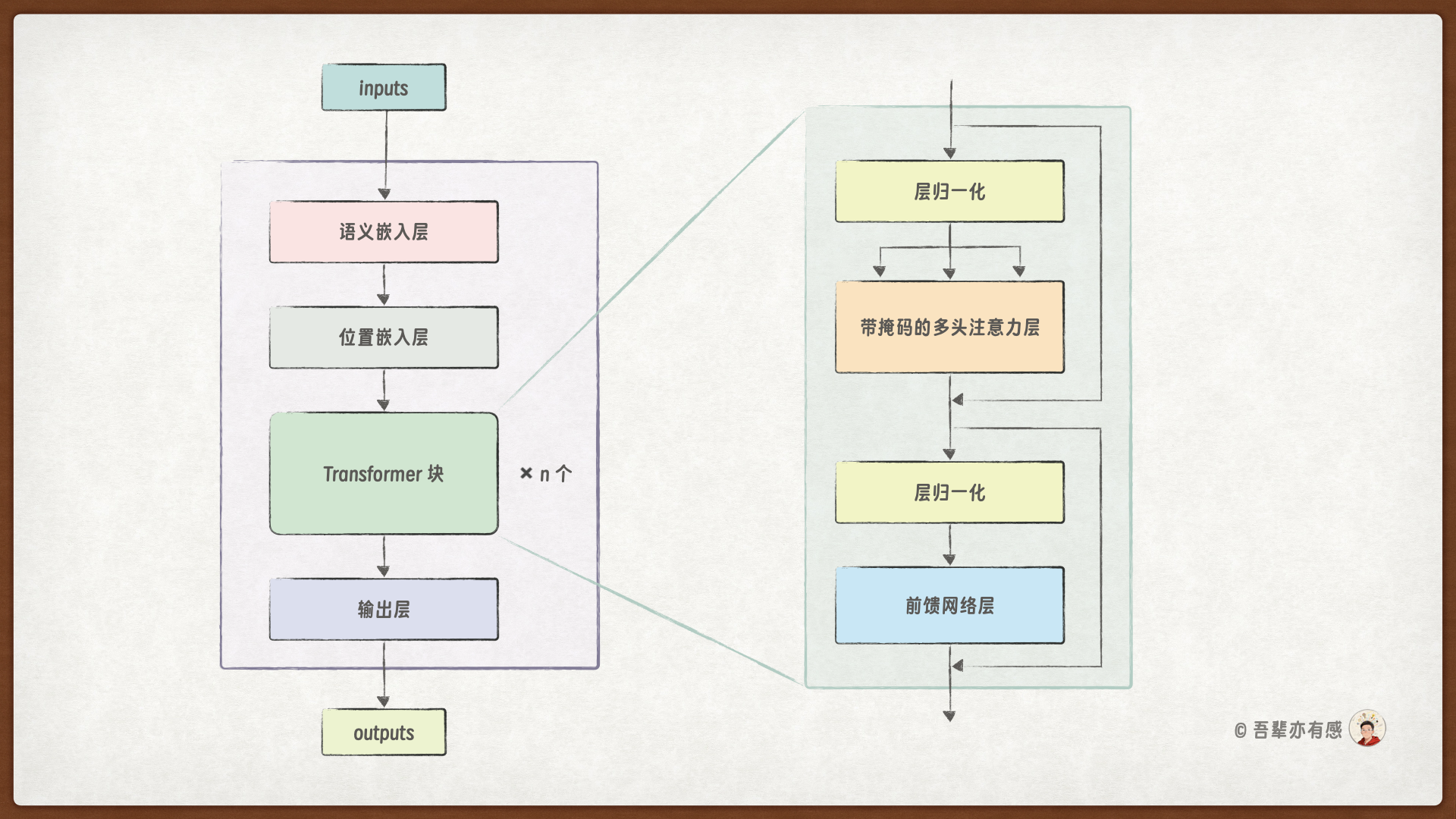
前面我们已经实现了 Transformer 块中所有的子层,本小节将继续实现完整的 Transformer 块。
29.2. 环境配置#
29.2.1. 安装依赖#
!pip install --upgrade dsxllm
29.2.2. 环境版本#
from dsxllm.util import show_version

show_version()
本书愿景:
+------+--------------------------------------------------------+
| Info |                  《动手学大语言模型》                  |
+------+--------------------------------------------------------+
| 作者 |                       吾辈亦有感                       |
| 哔站 |      https://space.bilibili.com/3546632320715420       |
| 定位 | 基于'从零构建'的理念,用实战帮助程序员快速入门大模型。 |
| 愿景 | 若让你的AI学习之路走的更容易一点,我将倍感荣幸!祝好😄 |
+------+--------------------------------------------------------+
环境信息:
+-------------+--------------+------------------------+
| Python 版本 | PyTorch 版本 | PyTorch Lightning 版本 |
+-------------+--------------+------------------------+
|   3.12.12   |    2.10.0    |         2.6.1          |
+-------------+--------------+------------------------+
29.3. Transformer Block#
在 GPT 模型中,Transformer Block 是模型的核心构建单元,它通过一些类复杂的计算,能不断提炼和深化对输入文本的理解,让每个位置的 Token 都能融合丰富的上下文信息。同时,GPT 模型可以使用多个 Transformer Block 层的堆叠来处理不同层次的特征,从而实现对复杂文本的有效建模。
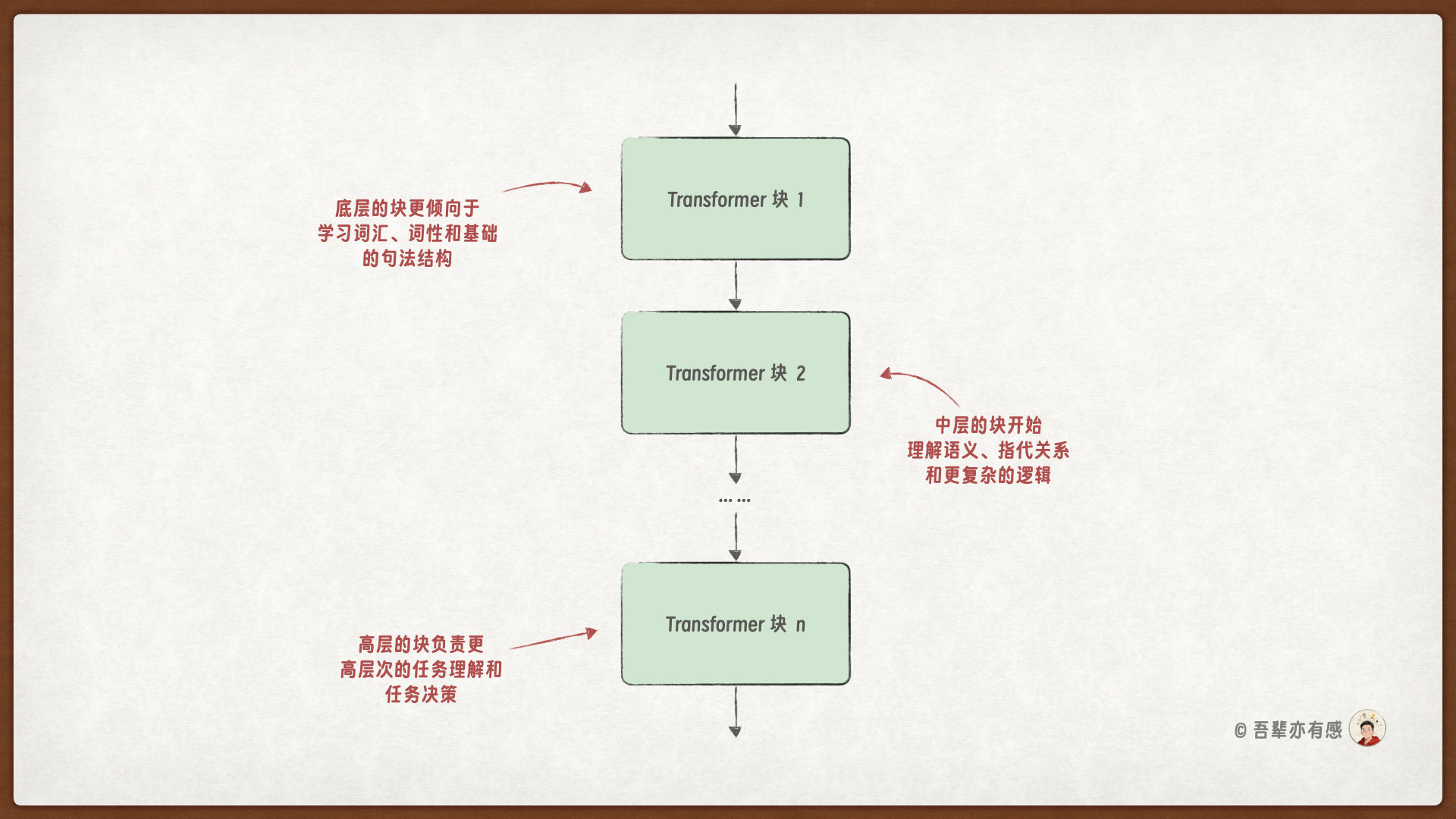
底层的块:更倾向于学习词汇、词性和基础的句法结构。
中层的块:开始理解语义、指代关系和更复杂的逻辑。
高层的块:负责主题归纳、概念抽象、逻辑推理等更高层次的语义理解和任务决策。
29.4. Transformer Block 的代码实现#
import torch

from dsxllm.gpt.layer import LayerNorm, MultiHeadAttention, FeedForward


class TransformerBlock(torch.nn.Module):
    """
    标准 Transformer 编码器块,包含多头自注意力和前馈网络,每个子层后均有残差连接和层归一化。

    Args:
        config (dict): 配置字典,必须包含以下键:
            - d_model: 模型维度
            - seq_len: 上下文长度
            - n_heads: 注意力头数
            - drop_rate: Dropout 概率
            - qkv_bias: QKV 投影是否使用偏置
    """

    def __init__(self, d_model, seq_len, n_heads, drop_rate=0.1, qkv_bias=False):
        super().__init__()

        self.attention_norm = LayerNorm(d_model)
        self.attention_layer = MultiHeadAttention(
            input_dim=d_model,
            output_dim=d_model,
            seq_len=seq_len,
            num_heads=n_heads,
            dropout=drop_rate,
            qkv_bias=qkv_bias,
        )

        self.feed_forward_norm = LayerNorm(d_model)
        self.feed_forward_layer = FeedForward(d_model)

        # Dropout 层,用于防止过拟合
        self.residual_dropout = torch.nn.Dropout(drop_rate)

    def forward(self, x):
        """
        前向传播。

        Args:
            x (torch.Tensor): 输入张量,形状为 (batch_size, seq_len, d_model)。

        Returns:
            torch.Tensor: 输出张量,形状相同。
        """
        # 注意力子层(残差连接)
        residual = x  # 保存输入作为残差连接
        x = self.attention_norm(x)  # 自注意力计算前对输入进行层归一化
        x = self.attention_layer(
            x
        )  # 应用多头注意力机制,输出形状为 [batch_size, seq_len, d_model]
        x = self.residual_dropout(x)  # 应用 Dropout 层,防止过拟合
        x = x + residual  # 将注意力子层的输出与输入残差相加,形成残差连接

        # 前馈子层(残差连接)
        residual = x  # 保存注意力子层的输出作为残差连接
        x = self.feed_forward_norm(x)  # 前馈计算前对输入进行层归一化
        x = self.feed_forward_layer(
            x
        )  # 应用前馈网络,输出形状为 [batch_size, seq_len, d_model]
        x = self.residual_dropout(x)  # 应用 Dropout 层,防止过拟合
        x = x + residual  # 将前馈子层的输出与输入残差相加,形成残差连接

        return x
29.5. Transformer Block 的详细信息#
from torchinfo import summary

# 超参配置
batch_size = 32
d_model = 128
num_heads = 8
seq_len = 10

# 创建模型实例
transformer_block = TransformerBlock(
    d_model=d_model, seq_len=seq_len, n_heads=num_heads
)

# 查看详细 Summary
summary(
    transformer_block,
    input_size=(batch_size, seq_len, d_model),
    col_names=("input_size", "output_size", "num_params"),
    row_settings=("var_names",),
)
========================================================================================================================
Layer (type (var_name))                       Input Shape               Output Shape              Param #
========================================================================================================================
TransformerBlock (TransformerBlock)           [32, 10, 128]             [32, 10, 128]             --
├─LayerNorm (attention_norm)                  [32, 10, 128]             [32, 10, 128]             256
├─MultiHeadAttention (attention_layer)        [32, 10, 128]             [32, 10, 128]             --
│    └─Linear (query_layer)                   [32, 10, 128]             [32, 10, 128]             16,384
│    └─Linear (key_layer)                     [32, 10, 128]             [32, 10, 128]             16,384
│    └─Linear (value_layer)                   [32, 10, 128]             [32, 10, 128]             16,384
│    └─Dropout (dropout)                      [32, 8, 10, 10]           [32, 8, 10, 10]           --
│    └─Linear (output_layer)                  [32, 10, 128]             [32, 10, 128]             16,512
├─Dropout (residual_dropout)                  [32, 10, 128]             [32, 10, 128]             --
├─LayerNorm (feed_forward_norm)               [32, 10, 128]             [32, 10, 128]             256
├─FeedForward (feed_forward_layer)            [32, 10, 128]             [32, 10, 128]             --
│    └─Linear (gate_layer)                    [32, 10, 128]             [32, 10, 512]             65,536
│    └─GELUActivation (activation_fn)         [32, 10, 512]             [32, 10, 512]             --
│    └─Linear (up_layer)                      [32, 10, 128]             [32, 10, 512]             65,536
│    └─Linear (down_layer)                    [32, 10, 512]             [32, 10, 128]             65,536
├─Dropout (residual_dropout)                  [32, 10, 128]             [32, 10, 128]             --
========================================================================================================================
Total params: 262,784
Trainable params: 262,784
Non-trainable params: 0
Total mult-adds (Units.MEGABYTES): 8.39
========================================================================================================================
Input size (MB): 0.16
Forward/backward pass size (MB): 4.92
Params size (MB): 1.05
Estimated Total Size (MB): 6.13
========================================================================================================================
29.6. Transformer Block 的应用实例#
29.6.1. 单个 Transformer Block 层的计算#
from dsxllm.util import print_table

# 超参配置
batch_size = 32
d_model = 128
num_heads = 8
seq_len = 10

# 创建输入张量
x = torch.randn(batch_size, seq_len, d_model)


# 创建模型实例
transformer_block = TransformerBlock(
    d_model=d_model, seq_len=seq_len, n_heads=num_heads
)

# 使用 Transformer Block 进行前向传播
attention_out = transformer_block(x)

# 打印 Transformer Block 的输入与输出
print_table(
    table_name="Transformer Block 的输入与输出",
    field_names=["Value", "Shape"],
    data=[["输入", x.shape], ["输出", attention_out.shape]],
)
Transformer Block 的输入与输出:
+-------+---------------------------+
| Value |           Shape           |
+-------+---------------------------+
|  输入 | torch.Size([32, 10, 128]) |
|  输出 | torch.Size([32, 10, 128]) |
+-------+---------------------------+
29.6.2. 多个 Transformer Block 层的计算#
from dsxllm.util import print_table

# 超参配置
batch_size = 32
d_model = 128
num_heads = 8
seq_len = 10
n_layers = 4

# 创建输入张量
x = torch.randn(batch_size, seq_len, d_model)


# 创建 n_layers 个 TransformerBlock 层堆叠的实例
transformer_blocks = torch.nn.Sequential(
    *[
        TransformerBlock(d_model=d_model, seq_len=seq_len, n_heads=num_heads)
        for _ in range(n_layers)
    ]
)

# 使用 Transformer Blocks 进行前向传播
attention_out = transformer_blocks(x)

# 打印 Transformer Blocks 的输入与输出
print_table(
    table_name="Transformer Block 的输入与输出",
    field_names=["Value", "Shape"],
    data=[["输入", x.shape], ["输出", attention_out.shape]],
)
Transformer Block 的输入与输出:
+-------+---------------------------+
| Value |           Shape           |
+-------+---------------------------+
|  输入 | torch.Size([32, 10, 128]) |
|  输出 | torch.Size([32, 10, 128]) |
+-------+---------------------------+
29.7. 答疑讨论#

○ 如果你觉得这篇文章有所帮助,欢迎将本文链接推荐给更多人——无论是分享到朋友圈、博客、社群,还是任何你常逛的地方。每一次转发,都会让它在搜索结果中更容易被有需要的人看到。